
Propagate means 'to sow'
Artists have 'propagandised' for politics and power from the very outset of making art. But saying ‘it’s always been the case’ disguises rather than illuminates.

Hello again,
Welcome to Clickbait Citizen
Having publishing Prompt: Five Arenas a few weeks ago, a look at a post-genocide vision of Gaza promoted by US President Trump, I invite you to take a step back and think about a few elementary definitions of propaganda and art-propaganda.
In Latin propagate means ‘to sow’. Maybe we can argue that humans began to propagate images of their politics and social arrangements from the very outset of art and image making in caves1 . Yet, when we say, ‘this is Propaganda’, we tend to mean manipulation, lies and deceit which recalls the worst historical examples of state terror. But this is a rather old-fashioned way to think. We cannot only refer retrospectively to the age of totalitarianism. We need to look at propaganda and art in contemporary politics. And thus we have to think about social media.
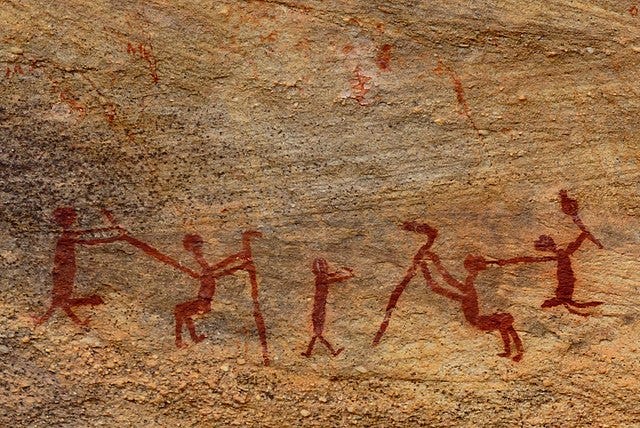
Serra da Capivara National Park, Brazil. Photo: Douglas Iuri Medeiros Cabral
In January 2025 Nobel prize winner Maria Ressa wrote that Facebook is a platform for 3.2 BILLION people around the planet for whom profit is more important than safety. The FB cave wall is owned by invisible forces who control the light, decides who can and cannot not see, the depth of field of the image and every algorithm in between.
That is the problem with social media - it's not social as the users cannot control it, and it's not media because it does not abide to media regulations2. With ‘Big Tech’ there is no technology released today literally anchored in facts. As Ressa says, “Generative AI, released in November 2022, is not anchored in facts - indeed, not being anchored in facts is a feature of its design”.
Jonas Staal suggests that the very idea that we can stand outside of propaganda, recognize it and resist it, merely because one lives in a democracy, is itself a product of propaganda. Exploring the relationship between propaganda and democracy does not mean that democracy can be equated with dictatorship however. But propaganda should be understood as an inherent part of our modernity and its technological infrastructure. 3
Our use of the word ‘democracy’ also needs to be handled with care. In Ancient Greece democracy was reserved for an elite. Western democracies instigated colonialism and global warfare. Erdogan, Trump and Putin all talk of ‘sovereign democracy’, Hungary’s Orban and Poland’s PiS (now in opposition) talk of ‘illiberal democracy’ and we have extreme right governments with their roots firmly embedded in fascist pasts in Italy and Austria and we watch senior members of Trump’s team giving Nazi salutes. Furthermore, there are dozens of examples in Europe’s post Second World War era in which democracies used ethnic cleansing and forced movements of populations as state sanctioned policy.
Propaganda and Art
“Propaganda does not have to seek objectivity for the truth... but exclusively has to serve our interests” Hitler, A. Mein Kampf
The first organised and sustained campaign of official film propaganda was most probably organized by the British in WW1. In 1917 US President Woodrow Wilson declared war on the Axis and as a result ‘the master narrative’ manufactured evidence of German deceit and atrocities which later were admitted having been totally fictional. Yet by 1936 writers such as Aldous Huxley were charting both political and commercial applications of propaganda techniques across wide swathes of human activity:
All over the world thousands upon thousands of men and women pass their whole lives denouncing, instructing, commanding, cajoling, imploring their fellows. With what results? One finds it rather hard to say. Most propagandists do their work in the dark, draw bows at a venture. They write but they don't know how far they will succeed in influencing their readers, nor what are the best means for influencing them, nor how long their influence will last. There is, as yet no science of propaganda. 4
All this, however, was about to change.
Keep reading with a 7-day free trial
Subscribe to Clickbait Citizen to keep reading this post and get 7 days of free access to the full post archives.